


Replacing a Bridge with Implants: How It Works & Benefits
Key Takeaways
- Replacing a bridge with implants moves support from the natural teeth on either side of the gap to titanium posts anchored directly in the jawbone.
- The switch spans five stages: digital planning, sectioning and removal of the old bridge, guided implant placement, healing, and fitting the final teeth.
- Treatment typically takes four to nine months, with osseointegration, the implant fusing to the bone, accounting for most of that time.
- The benefits are structural: the supporting teeth stop carrying the load, bone in the gap is stimulated again, and once the gap is restored with separate implant crowns, cleaning returns to normal brushing and flossing.
- Arnold Dental & Implant Centre plans, places and restores bridge-to-implant cases at our Nottingham practice, so one team handles the switch start to finish.
What Replacing a Bridge with Implants Involves
A bridge is replaced with implants by removing the old bridge and placing titanium implants into the jawbone, so the new teeth are held by bone instead of by the natural teeth on either side. It happens in five stages across four to nine months: digital planning, bridge removal, guided implant placement, healing, and fitting the final crown or implant bridge.
Most patients assume the decision is about the bridge itself. It is almost always about the two teeth underneath it. A bridge ties three teeth together, so one failure takes out the whole unit, and each replacement removes more structure from the same abutment teeth until crowns, root canal treatment, or extraction become likely. What the clinician finds when the bridge comes off- whether the abutment teeth are sound, decayed, or fractured- shapes every decision that follows, from implant count to healing time to the type of final restoration.
Arnold Dental & Implant Centre handles the full sequence at our Nottingham practice. The same team scans, plans, places, and restores, with bespoke 3D-printed surgical guides included as standard.
Arnold Dental & Implant Centre: Nottingham’s Complete Smile Solution
GDC-Registered Team | Implants to General Care | Trusted Local Dental Care

Arnold Dental provides end-to-end dental care for the whole family, from routine check-ups to life-changing implant treatments. Their fully managed implant process, from consultation through to restoration and aftercare, replaces missing teeth with natural-looking, permanent results, handled entirely in-house to save you time and cost.
What you get:
✓Dental implants managed start to finish, including bespoke surgical guides and digital planning
✓Full smile restorations combining implants, bridges, veneers, and whitening
✓Preventive and restorative care, orthodontics, and facial aesthetics under one roof
✓All clinicians registered with the General Dental Council
Your smile deserves expert care from people who know your name.
How Replacing a Bridge with Implants Works
At Arnold Dental & Implant Centre, every bridge-to-implant case follows five stages, each building on the previous one.
Stage 1: Assessment & Digital Planning
We check the condition of the bridge, the abutment teeth, the gums, and the bone in the gap. An intraoral scanner records the shape of your mouth in a few minutes without impression trays, and Cone Beam Computed Tomography (CBCT) imaging shows bone height, bone width and the position of nerves and sinuses in three dimensions.
Those two records merge into a single digital model, and we decide implant positions on screen before any surgery. At this stage, planning shows whether there is enough bone for the desired implant length, whether grafting is likely, and how many implants the case actually needs.
The scan also indicates the state of the teeth under the bridge. If an abutment tooth shows deep decay or a fractured root on the CBCT, we plan to remove it from the outset rather than find it mid-treatment.
Stage 2: Removing the Old Bridge
We section the bridge with a handpiece and lift it off in pieces, keeping force off the supporting teeth. Cutting it rather than levering it out matters, because an intact bridge cemented across two teeth can pull one of them with it.
The teeth underneath are then assessed properly for the first time in years. Sound abutment teeth are cleaned up and either left alone or restored with a crown, depending on how much structure remains after the original preparation.
If an abutment tooth is badly decayed or fractured, we remove it at this appointment and clean the socket of any infected tissue. That changes the plan because the number of implants depends on how many teeth you’re replacing, not the size of the original bridge.
Stage 3: Implant Placement Using a Surgical Guide
We 3D print a bespoke surgical guide from the digital plan, included as standard rather than charged as an extra. It seats over your teeth or gums and carries metal sleeves that direct the drill to the planned angle, depth, and position.
The guide keeps the surgical phase short and predictable. Because the position was settled on screen, the implant is placed as close as possible to where the final crown needs it to be, which affects how natural the finished tooth looks at the gumline and how easy it is to clean.
Our clinicians place implants under local anesthetic, and most single-site cases take under an hour. If a failing tooth was just removed and the socket walls and bone volume allow it, we can place an implant the same day.
Stage 4: Healing & Integration
The implant fuses with surrounding bone over roughly three to six months, a process called osseointegration. Dense bone in the lower jaw generally integrates faster than the softer bone toward the back of the upper jaw, which is why timelines vary between patients.
Where the ridge has shrunk under the old bridge, we add grafting material to rebuild the site, either at placement or several months beforehand if a larger volume is needed. Shorter or angled implants sometimes avoid grafting altogether.
In most cases, you won’t be left with a visible gap during any of this. A temporary tooth, either removable or fixed, fills the space and is shaped to sit clear of the healing implant beneath it.
Stage 5: Fitting the Final Teeth
Once the implant is stable, we scan again and design the final crown or implant bridge to match the shape, contour, and shade of your natural teeth. We design and print in-house, so we handle shade adjustments and contact-point tweaks directly instead of sending the case to an external laboratory and waiting.
We fix the tooth to the implant, either screwed or cemented, and check your bite in normal closure and side-to-side movement. Getting that loading right protects the implant over the years.
You’ll then learn how to clean around the restoration and schedule reviews. Those appointments track the gum level and bone around the implant, which helps catch problems early.
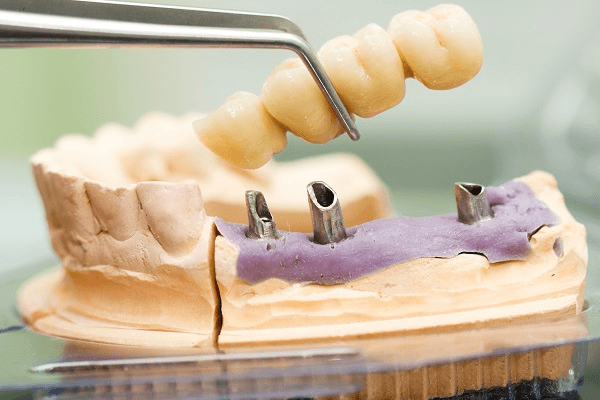
A surgical guide and digital planning ensure each implant is placed at the exact angle, depth, and position needed.
Benefits of Replacing a Bridge with Implants
Your Natural Teeth Are Left Alone
An implant carries its own load, so the teeth on either side no longer support a false tooth. Healthy abutment teeth can stay untouched instead of being prepared again for a replacement bridge.
This matters most on a second failure. Each new bridge removes more structure from the same teeth, and there is a limit before crowns, root canal treatment, or extraction become likely.
There is a knock-on effect too. A bridge ties the fate of three teeth together, so one failure takes out the whole unit, while separate implant teeth fail independently if they fail at all.
Bone in the Gap Stays Stimulated
A titanium implant transmits chewing forces into the jawbone much like a natural root. That stimulation helps maintain bone volume in a site that was receiving nothing while the bridge was in place.
The difference usually shows at the gumline. A bridge develops a visible dark space underneath as the ridge shrinks away from the false tooth, while an implant crown emerges from the gum in the same way a natural tooth does.
Maintaining bone volume also supports the next stage of treatment, should you need it. A site that has kept its width and height is far simpler to work with than one that requires grafting first.
Cleaning Becomes Straightforward
Bridge units are joined, so floss has to be threaded underneath the false tooth rather than passed between teeth. Many people find this awkward and quietly stop doing it, which is exactly how decay develops at the margins.
Implant-supported teeth are usually separate units. Brushing, flossing, and interdental brushes reach the surfaces that matter, and hygiene appointments provide clear access, though implants still need regular professional maintenance to keep the surrounding gum and bone healthy.
Chewing Feels Firm
Support comes from bone rather than cement on two prepared teeth, so implant teeth don’t develop the slight give an ageing bridge often has. That movement is usually what patients notice first when a bridge starts to fail, well before any visible sign appears.
An implant also handles bite force differently. A bridge spreads the missing tooth’s load across two abutment teeth and their roots, while an implant absorbs force directly at the site where the tooth used to be, where the load was originally distributed.
The practical result is that patients who have been favouring one side of the mouth generally go back to chewing evenly. Hard and chewy foods stop being something to plan around.

Implants preserve healthy teeth, maintain jawbone density, and simplify daily cleaning compared to traditional dental bridges.
Replace Your Bridge Without Changing Clinics at Arnold Dental & Implant Centre
Bridge-to-implant cases rarely follow the original plan exactly, because what sits under the old bridge is only fully visible once it comes off. A decayed abutment tooth changes the implant count, a thin ridge changes the healing timeline, and each revision needs the same team that started the case to keep treatment moving without delays or new referrals.
At Arnold Dental & Implant Centre in Nottingham, the same clinicians scan, plan, place, and restore under one roof, with surgical guides included as standard rather than charged as an extra. If your bridge is loose, dark at the margins, or overdue for assessment, book a consultation with us.
Frequently Asked Questions (FAQs)
Does removing an old bridge damage the teeth underneath?
Removal is done by sectioning the bridge so the supporting teeth are not stressed. Damage found at this stage is usually decay that developed under the bridge over several years, rather than anything caused by the removal itself.
Can an implant be placed the same day the bridge comes off?
Sometimes. Immediate placement depends on bone volume at the site and whether infection is present around the abutment tooth. If either is a problem, the socket heals for a few months before the implant goes in.
Is the procedure painful?
Implant placement is carried out under local anaesthetic, so the surgery itself is not painful. Mild soreness and swelling for a few days afterward is normal, and it is generally managed with over-the-counter pain relief and the aftercare instructions you are given.
What happens if one abutment tooth is fine and the other has failed?
The healthy tooth is kept and the failed one removed. The replacement is planned around what remains, which may mean a single implant and crown, or two implants supporting a shorter fixed bridge across the space.
Why choose Arnold Dental & Implant Centre to replace a bridge with implants?
Bridge cases often change once the old work comes off, and Arnold Dental & Implant Centre assesses, places, and restores in the same practice, so a revised plan does not mean a new referral. Your surgical guide is included as standard.
*Note: The information in this post is for general guidance only and does not constitute professional medical or dental advice. Individual outcomes vary depending on personal health factors, and any pricing mentioned is indicative only and subject to change. Always consult a qualified dental professional before making any treatment decisions. Contact Arnold Dental & Implant Centre to book a consultation.